


Article by: Ryan Hasty, Senior Director – Strategy & Business Development
July 29th 2026
Voice termination charges are going to zero. Not by market pressure. By the FCC, on a set schedule.
In February, the Commission proposed moving every remaining intercarrier access charge to bill-and-keep over 24 months. Two weeks ago, the FCC spent two days in Washington workshopping the all-IP transition with the industry. The per-minute access charges carriers have billed each other since the Bell breakup are being walked to zero, in public, on the docket. The Commission concluded back in 2011 that the incremental cost of terminating a call is “very nearly zero.” Fifteen years later, it is finishing that thought: if the cost is nearly zero, the charge should be zero, and there should be a date on it.
My team recently sat down to discuss this topic with one of the sharpest interconnection minds I know, and as a result, I have spent numerous hours studying these FCC dockets closely. Partly because our customers sit all over this call path, and partly because this individual laid it out to us as bluntly as possible:
“If you operate as an intermediate carrier, or you rely on one, you need to be paying attention right now.”
Reading between the lines a bit after that discussion, I realized he may have been underselling it. There are actually three proceedings, all moving in the same direction, and together they change what it takes to participate in the US voice market.
The Access Charge Repricing:
The February NPRM (FCC 26-11) finishes what the 2011 USF/ICC Transformation Order started. Everything still carrying an access charge today, originating switched access, tandem switching and transport, dedicated transport, the last 8YY elements, and VoIP-PSTN charges, would all step down on one uniform schedule: 33% at month zero, 33% at month twelve, and 34% at month twenty-four. Zero.
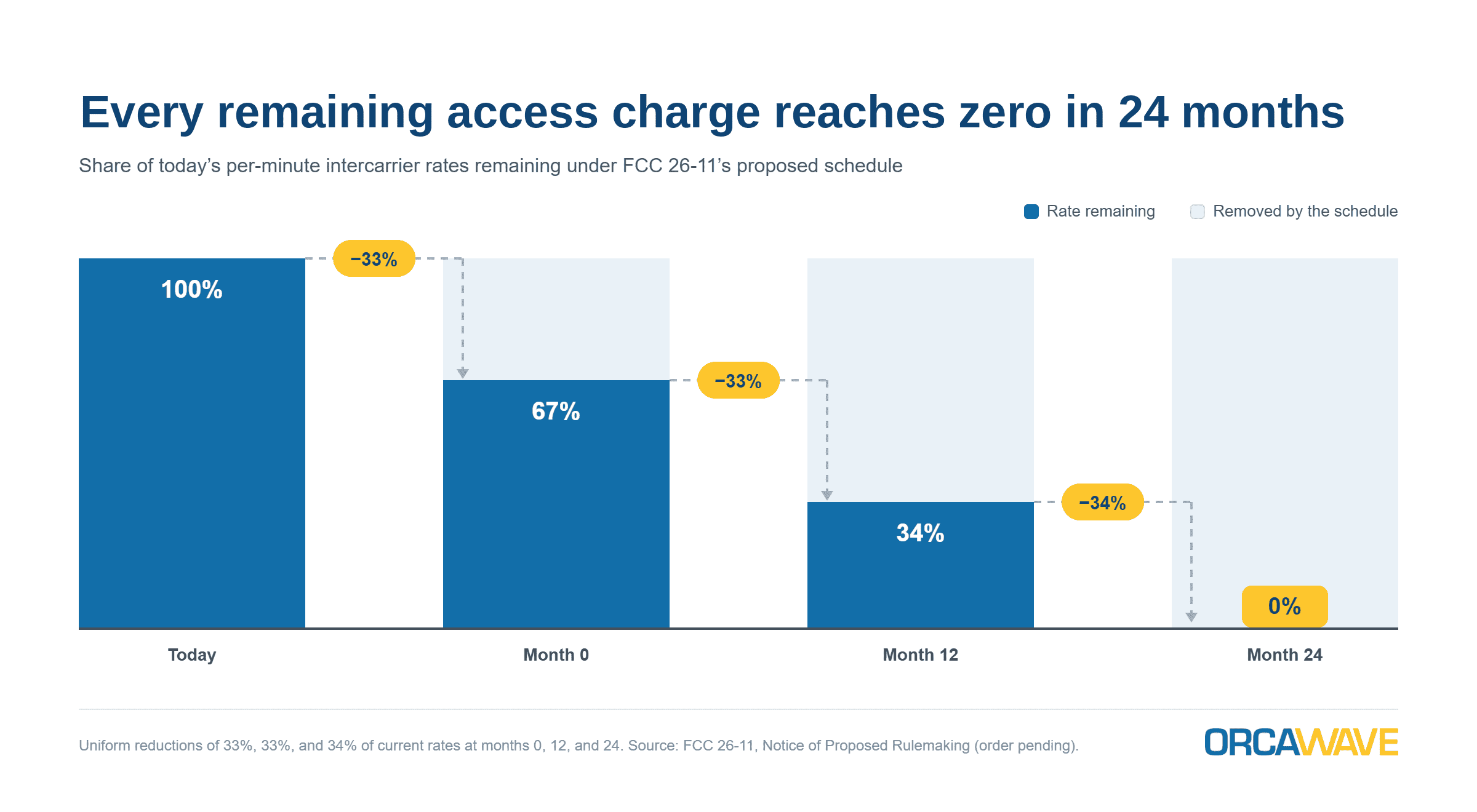
The mechanics are worth a minute to truly understand. The reductions land at the annual access tariff filings, the remaining uncapped intrastate originating rates get frozen 30 days after an order publishes, and once the step-down completes, the Commission proposes to forbear from Section 203 tariffing for access charges entirely. No more access tariffs. Whatever anyone charges after that lives in a negotiated commercial agreement or a service guide, not a filed rate.
Two things in the document jumped out at me:
- The FCC is asking pointed questions about intermediates. Its own words: the transition may affect “intermediate access providers, such as tandem providers or centralized equal access providers, that arguably stand in distinctive postures in the call flow and may not have end users of their own.” The document even sketches the end state, noting that an independent third-party tandem “would not be prohibited from charging contractually negotiated prices to its LEC-customers.” The revenue does not vanish. It moves from tariff pages to negotiating tables, and pricing power moves with it. Some of those negotiations are going to be uncomfortable.
- Bill-and-keep needs something the old regime never did: a defined “network edge,” the point where financial responsibility flips from the sending carrier to the receiving one. Access charges used to answer that question automatically. The NPRM asks whether states or the Commission should draw the line, floats a single point of interconnection per state during the transition, and proposes that any carrier still electing to run TDM should bear its own conversion costs. Every one of those answers moves real transport dollars, and the document adds one more signal worth underlining: transit service “may become critical when IP interconnection is the default.” That is about as close as a regulator gets to telling you where intermediary value migrates next.
Comments on this one closed in June. The July workshop covered interconnection, completing bill-and-keep, and High-Cost reform. Simply put: This order will take time, and the direction will not change.
Know Your Upstream Provider, and Prove It:
The second proceeding turns “trust your carrier partners” into a federal compliance program. The Know-Your-Upstream-Provider FNPRM, published July 9th, would require any provider accepting upstream traffic to run a documented program across five categories: information collection, compliance review, verification, monitoring, and responsive action. The collection list is not a formality. Legal identity with supporting records; beneficial owners down to 10% stakes, with government-issued IDs; financial details; a physical address that is not a P.O. box or a virtual office; and whether any other provider has refused or discontinued service to them. This verification inherently would require getting a principal on the phone.
From there it becomes an operating obligation: continuous call analytics on every upstream partner, records retained for at least four years, and a duty to refuse or discontinue service under an “objectively reasonable” standard, with a safe harbor for providers who pull the trigger in good faith. Intermediate providers, resellers, and least-cost routing operations are squarely in scope.
The timing has teeth too. The rules would take effect roughly a year after a final order publishes, and within six months of that date, providers would owe a one-time review of every existing upstream relationship, not just new ones. Nobody gets grandfathered.
I began my career in finance before making the move over to telecom, so this rhymes for me. Banks lived this exact arc with Know Your Customer (KYC) twenty years ago. The firms that treated it as a data problem built moats. The ones that treated it as a checkbox eventually wrote checks to regulators instead. Continuous monitoring of upstream traffic is a data engineering problem wearing a regulatory costume, and you cannot monitor what you never mediated. Comments are due August 10th, replies by September 8th.
A Database That Decides Market Access:
The third proceeding involves a database most people outside this industry have never heard of. Under current rules, downstream providers may only accept traffic from providers listed in the Robocall Mitigation Database. Removal means you are functionally cut off from the US voice network, and removal is not hypothetical: the Commission pulled 185 providers in a single action last August, and it has said openly that it is looking at whether bad actors are parking dummy filings in the database to onboard traffic quickly.
The draft FNPRM released July 1st would raise the bar to stay listed, which means deeper ownership and principal disclosures, separate filings for each affiliate that independently qualifies as a provider, a certified 24-hour traceback response, scrutiny of filings prepared by third parties, and a discussion of who counts as a “voice service provider” that is broad enough to reach platforms, call centers, SaaS products, and AI companies touching US numbers. Whatever their pitch decks may say.
Market access in this industry is being redefined. Not spectrum. Not switches. A filing.
Entropy, Not Fraud:
My time thus far in this industry taught me that the enemy is rarely fraud. Fraud is dramatic and eventually gets caught. The real enemy is entropy. A rate table that never updated; a credit that expired unclaimed; a record format that drifted two fields to the left in March and nobody noticed until Q3. None of it is typically malicious; however, all of it is money, and at modern volumes, a rounding-error percentage could be somebody’s entire margin.
Every repricing event rewards the same people: the ones who can see their positions at the line-item level while everyone else reads monthly summaries, and a 24-month step-down of every remaining access charge is exactly that kind of event. When the rules change, your records are the only thing standing between you and whatever the new math says you owe. Most companies will discover their data quality the expensive way: mid-transition. The disciplined ones are auditing now, while it is still cheap.
Where Orca Wave Fits:
This is the part where I will talk about us, how we differentiate from the market, and how we are well positioned to help our customers weather what is coming. I wrote this article purely to inform, so I will keep this brief.
Orca Wave has spent over twenty years building exactly the layer these proceedings make matter. Our BlueWater platform processes more than 15 billion call detail records (CDRs) every month, normalizing them across carrier formats into a single, auditable view, to provide our customers with a source of truth for what they are actually being invoiced. That is the raw material for everything above: per-record cost answers through the step-down, analytics-grade monitoring of upstream traffic, and line-item invoice validation that catches a misapplied rate against the tariff step actually in force… before it compounds through three sequential cycles.
That is not to say routing stops mattering when termination is free. Rather, it stops being an arbitrage problem and becomes a cost-control and compliance problem, and the routing logic has to keep adapting as the carrier economics shift underneath it through the transition. BlueWater’s intelligent routing was built for exactly that. Our platform is SOC 2 Type II and ISO 27001 certified, and runs dual-hosted on Azure and AWS, so multi-year retention and produce-on-request evidence are not new obligations for us. They are simply another day at the (virtual) office.
If you already run traffic through BlueWater, most of the checklist below is happening on your behalf today. If you do not, the next two years will give you a very good reason to have a chat with us.
The carriers that come through this transition well will not be the ones with the best rates. They will be the ones with the best records. That has been Orca Wave’s thesis since 2002… long before the FCC put a date on it.
Between Now and the Order:
Five things worth doing this quarter:
- Model the 33-33-34 access charge step-down against your actual traffic, on both the revenue you collect and the charges you pay.
- Audit your record quality while it is cheap. Line-item visibility is the prerequisite for everything else here.
- Start the upstream evidence trail now. The five KYUP categories describe a monitoring pipeline, and the providers who treat it as one will have the cheapest compliance and the best data.
- Pull up your Robocall Mitigation Database filing and check it for accuracy, completeness, and affiliate coverage. Treat a stale filing like the outage risk it is.
- File comments if you have a position. KYUP is open through August 10th with replies due September 8th, and the record will be shaped by whoever shows up.
For further questions about what this means for your traffic, your records, or your organization, please feel free to reach out at rhasty@orcawave.net.
Sources:
FCC 26-11, Reforming Legacy Rules for an All-IP Future (NPRM, Feb. 18, 2026): docs.fcc.gov/public/attachments/FCC-26-11A1.pdf
IP Transition Workshop agenda, July 15-16, 2026 (DA 26-665): docs.fcc.gov/public/attachments/DA-26-665A1.pdf
FCC 26-32, Know-Your-Upstream-Provider FNPRM (Federal Register, July 9, 2026): federalregister.gov/documents/2026/07/09/2026-13874
Draft FNPRM, Improving the Effectiveness of the Robocall Mitigation Database (July 1, 2026): docs.fcc.gov/public/attachments/DOC-422744A1.pdf
FCC removal of 185 providers from the RMD (Aug. 6, 2025): docs.fcc.gov/public/attachments/DOC-413519A1.pdf
The FCC Is Repricing Telecom. The Winners Will Be Decided by Their Records.
Voice termination charges are going to zero. Not by market pressure. By the FCC, on a set schedule.

Considerations For Evaluating an OSS/BSS and Switch Provider
December 19, 2018 With something as business-critical as your OSS/BSS, or operations support system/business support system, it’s important to understand the factors in finding the

Why Messaging?
The Orca Wave team has spent the past three years reviewing in depth the “messaging marketplace” to determine the productive role we can play with
The FCC Is Repricing Telecom. The Winners Will Be Decided by Their Records.
Voice termination charges are going to zero. Not by market...
Read More
Considerations For Evaluating an OSS/BSS and Switch Provider
December 19, 2018 With something as business-critical as your OSS/BSS,...
Read More


